
Driveways, lots and private lanes across Allegheny County
Asphalt Paving in Pittsburgh, PA
New asphalt built for steep lots, wet hillsides and freeze-thaw winters, plus the repair and sealing that keeps it in shape.
- Free on-site estimates
- Written, itemized quote with base depth and compacted asphalt thickness
- PA One Call locates requested before any digging or grading
Paving a City Built on Hills
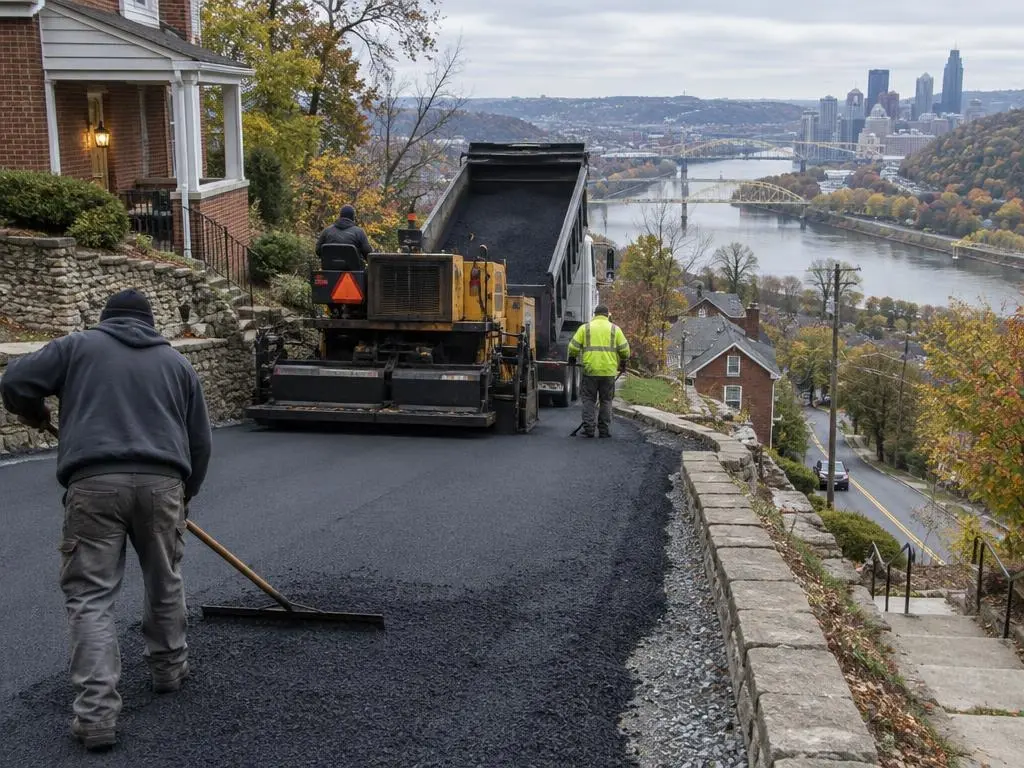
Asphalt paving in Pittsburgh is shaped by three things: slope, water and winter. The city climbs from about 710 feet at the rivers to 1,370 feet on its highest ground, more than a quarter of its neighborhood names refer to hills or heights, and many streets are steep two-lane roads. Add close to 40 inches of rain and melted snow a year and about 44 inches of snowfall, and a driveway here gets tested hard. Built for those conditions, asphalt can last decades. Laid thin over a poor base with no plan for water, it starts cracking and breaking at the edges within a few winters.
Freeze, thaw and salt
Asphalt does not usually fail because it is too thin on day one. It fails because water gets in. A crack opens, rain and snowmelt soak into the stone base, and when the temperature drops below freezing that water expands. Pittsburgh winters swing above and below freezing again and again, so the cycle repeats all season. Each round lifts and loosens the pavement a little more, until a crack becomes a pothole and a pothole becomes a failed section. Plows, shovels and de-icing salt then work on the weakened surface.
That is why the small jobs matter. Sealing cracks in the fall, patching failed spots before winter and sealcoating on a regular schedule keep water out of the base. A new driveway is built with the same goal: a compacted crushed-stone base that drains, a dense, well-rolled asphalt mat, and a surface shaped so water runs off instead of sitting.
Steep driveways and hillside lots
A short, steep driveway that drops from the street to a basement garage, or climbs from the road to a house set high on a lot, is ordinary here. On a steep grade the asphalt has to be placed and rolled carefully so it compacts fully and does not shove, the transition at the street has to be smooth enough that cars do not scrape, and the bottom of the drive must not send water against the garage door or the foundation. We check the grade at both ends at the estimate and plan the drainage before we talk about thickness.
Hillsides and water
Pittsburgh's soft, layered hillside soils and shale are known for being unstable when wet. After the record-wet year of 2018, Pittsburgh and the surrounding counties logged more than 200 landslides. Most driveway problems are far smaller than that, but they come from the same source: water that collects and soaks into the slope. Downspouts that empty onto the drive, runoff from the street, and low spots that hold puddles all weaken the base. We point out where a swale, drain, or redirected downspout will protect the new pavement and the ground beside it.
City streets, borough roads and state highways
Where your driveway meets the road decides whose rules apply. Inside the City of Pittsburgh, a new or changed curb cut starts with a Building and Development Application through the OneStopPGH portal. The Department of Mobility and Infrastructure (DOMI) reviews the design and issues a curb cut sub-permit before work begins. DOMI's standard residential curb cut is up to 8 feet wide, or 16 feet where the lot has 40 feet of frontage, if site conditions allow. Outside the city, each borough and township handles its own driveway and curb cut approvals. If your driveway connects to a state highway, constructing or altering it needs a highway occupancy permit from PennDOT. We sort out which applies at the estimate. Before any machine digs or grades, we contact PA One Call (811) at least three business days ahead.
What a new driveway job includes
- Measuring, checking grade at the garage and street, and noting the road connection
- Removing old asphalt, concrete or worn-out gravel
- Digging out soft or wet base and replacing it with compacted crushed stone
- Grading and compacting the stone base to the depth in your quote
- Placing and rolling hot-mix asphalt to the stated compacted thickness
- Smooth transitions at the street, garage slab and walks
- First-season care instructions and a sealcoat timeline
Built to be maintained
No driveway in a freeze-thaw climate is maintenance-free. The difference between one that lasts 15 years and one that lasts 30 is usually what happens after it is paved. We tell you when to sealcoat, what kinds of cracks to watch for, and when a small repair now will save a bigger one later.
Where We Work
We are based in Pittsburgh and work across Allegheny County. In the city itself, many homes sit on steep, narrow lots with short driveways and tight access, and curb cuts go through DOMI. South of the rivers, Mount Lebanon, Bethel Park and Upper St. Clair are mostly established neighborhoods with long-lived driveways due for resurfacing or replacement. East toward Penn Hills, Plum and Monroeville, lots are larger and rolling, with longer driveways and more gravel to convert. North of the city, Ross Township, Shaler and McCandless mix older hillside streets with newer subdivisions. Each borough and township sets its own driveway and curb cut process, and roads such as US 19, PA 51 and PA 8 are state highways where PennDOT rules apply. Each town page below covers what is particular to that community.
- Asphalt Paving in Pittsburgh, PA
- Asphalt Paving in Penn Hills, PA
- Asphalt Paving in Mt. Lebanon, PA
- Asphalt Paving in Bethel Park, PA
- Asphalt Paving in Ross Township, PA
- Asphalt Paving in Monroeville, PA
- Asphalt Paving in Shaler Township, PA
- Asphalt Paving in McCandless, PA
- Asphalt Paving in Upper St. Clair, PA
- Asphalt Paving in Moon Township, PA
- Asphalt Paving in Cranberry Township, PA
- Asphalt Paving in Plum, PA
- Asphalt Paving in Baldwin, PA
- Asphalt Paving in West Mifflin, PA
- Asphalt Paving in Murrysville, PA
- Asphalt Paving in Peters Township, PA
- Asphalt Paving in South Park Township, PA
- Asphalt Paving in McKeesport, PA
- Asphalt Paving in Hampton Township, PA
- Asphalt Paving in Robinson Township, PA
- Asphalt Paving in Franklin Park, PA
- Asphalt Paving in Scott Township, PA
- Asphalt Paving in Wilkinsburg, PA
- Asphalt Paving in North Huntingdon, PA
- Asphalt Paving in Whitehall, PA
Why Homeowners Call Elite Asphalt Paving Pittsburgh
Base first
Soft or wet base is dug out and replaced with compacted crushed stone before any asphalt goes down.
Numbers in writing
Stone base depth and compacted asphalt thickness are stated for each area of the job.
Water planned for
Grade, crown and runoff paths are set so rain and snowmelt leave the pavement instead of soaking in.
Permits sorted early
We tell you whether DOMI, your borough or township, or PennDOT rules apply where the driveway meets the road.
Common Questions
How much does asphalt paving cost in Pittsburgh?
National cost guides put new asphalt driveways at about $5 to $12 or more per square foot (HomeGuide) and $7 to $15 per square foot (Angi). HomeGuide lists a 600-square-foot driveway at roughly $3,000 to $7,200. Removal, steep grades, tight access and base repair change the total, so we price your driveway in writing after the site visit.
Why do driveways around Pittsburgh crack and pothole so quickly?
Mostly freeze-thaw. Water gets into cracks and the stone base, freezes, expands and loosens the pavement, and Pittsburgh winters repeat that cycle many times. A thin section over a weak base fails first. Sealing cracks before winter and building a draining stone base prevent most early failures.
Do I need a permit for a driveway in Pittsburgh?
In the City of Pittsburgh, a new or changed curb cut needs a Building and Development Application through OneStopPGH and a DOMI curb cut sub-permit before work starts. Outside the city, your borough or township handles driveway approvals. Driveways connecting to a state highway need a PennDOT highway occupancy permit to be built or altered. We confirm what applies to your address before scheduling.
Can you pave over my old asphalt driveway?
If the old driveway is firmly supported and the cracking is on the surface, an overlay can work and costs less than full replacement. HomeGuide notes overlays typically save 20 to 30 percent. If there are heaved or sunken areas, ruts or broken edges, the base has failed and new asphalt on top will crack in the same places.
When is paving season in Pittsburgh?
Roughly spring through late fall, when the ground is thawed and dry and temperatures let hot mix be compacted before it cools. Asphalt plants and paving crews slow down or stop in the coldest months. Winter is a good time to get an estimate and a spot on the spring schedule.
How soon should a new driveway be sealcoated?
Cost guides say to wait three to six months so the asphalt can cure, and to seal in dry weather between about 50 and 95 degrees. A driveway paved in late summer is often sealed the following spring. After that, resealing every few years helps protect it from water, salt and sun.
Can a steep driveway be paved with asphalt?
Yes. Asphalt gives good traction and is easier to repair than concrete on a slope. Steep driveways need careful rolling so the mat compacts and does not shove, a smooth transition at the street, and a plan for where the water goes at the bottom.
What should I compare when getting asphalt paving quotes in Pittsburgh?
Look past the total. A sound quote states the stone base depth, the compacted asphalt thickness, whether soft base will be dug out, how the street transition and drainage will be handled, and who takes care of the curb cut or PennDOT permit. Two bids that look close on price can differ on every one of those points.
Asphalt Services Around Pittsburgh
Six services that cover a driveway or lot from the first load of stone through the winters that follow.
Asphalt Driveway Paving
New and replacement driveways on a compacted, draining stone base, with grade and transitions set for Pittsburgh's slopes.
Learn more →Asphalt Repair
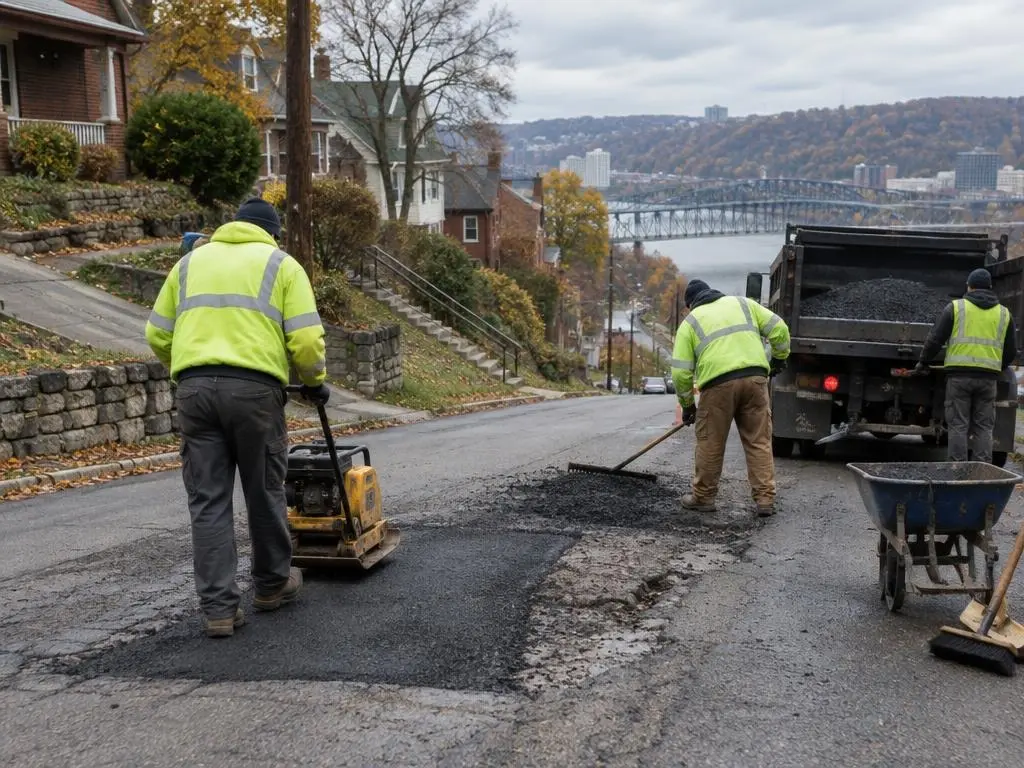
Saw-cut pothole and patch repair, heaved and sunken sections, and broken edges fixed down to a sound base.
Learn more →Asphalt Crack Sealing
Cracks cleaned and filled with hot rubberized sealant before winter, so water and frost cannot get into the base.
Learn more →Asphalt Resurfacing
A new layer of hot mix over a driveway or lot that is worn and cracked on top but still solid underneath.
Learn more →Sealcoating
A protective coat against water, de-icing salt, oil and sun, applied after cracks are sealed and the surface is cleaned.
Learn more →Parking Lot Paving
New lots, reconstruction and overlays for businesses, churches and multifamily properties, with drainage and phasing planned.
Learn more →Get an Asphalt Paving Estimate
Free on-site estimates in Pittsburgh and across Allegheny County.